“I don’t know our ROPLI.” — “Are you sure?”
“I don’t think we can measure that.” — “You know the costs. You see the outcomes. But have you connected the two?”
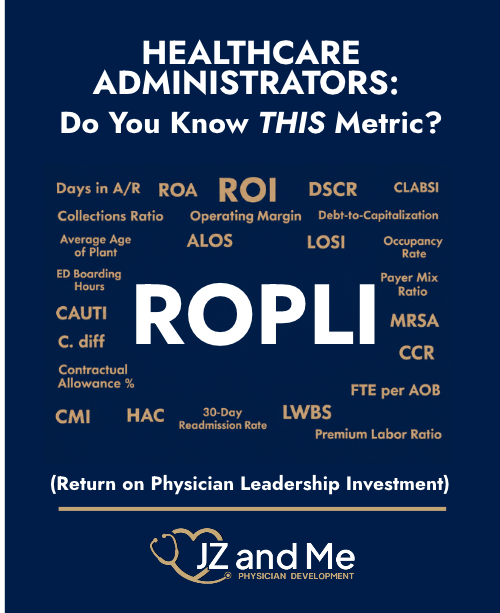
You’ve never heard of it because I just invented (and trademarked) it: ROPLI™ (pronounced Rop’–Lee). Return On Physician Leadership Investment.
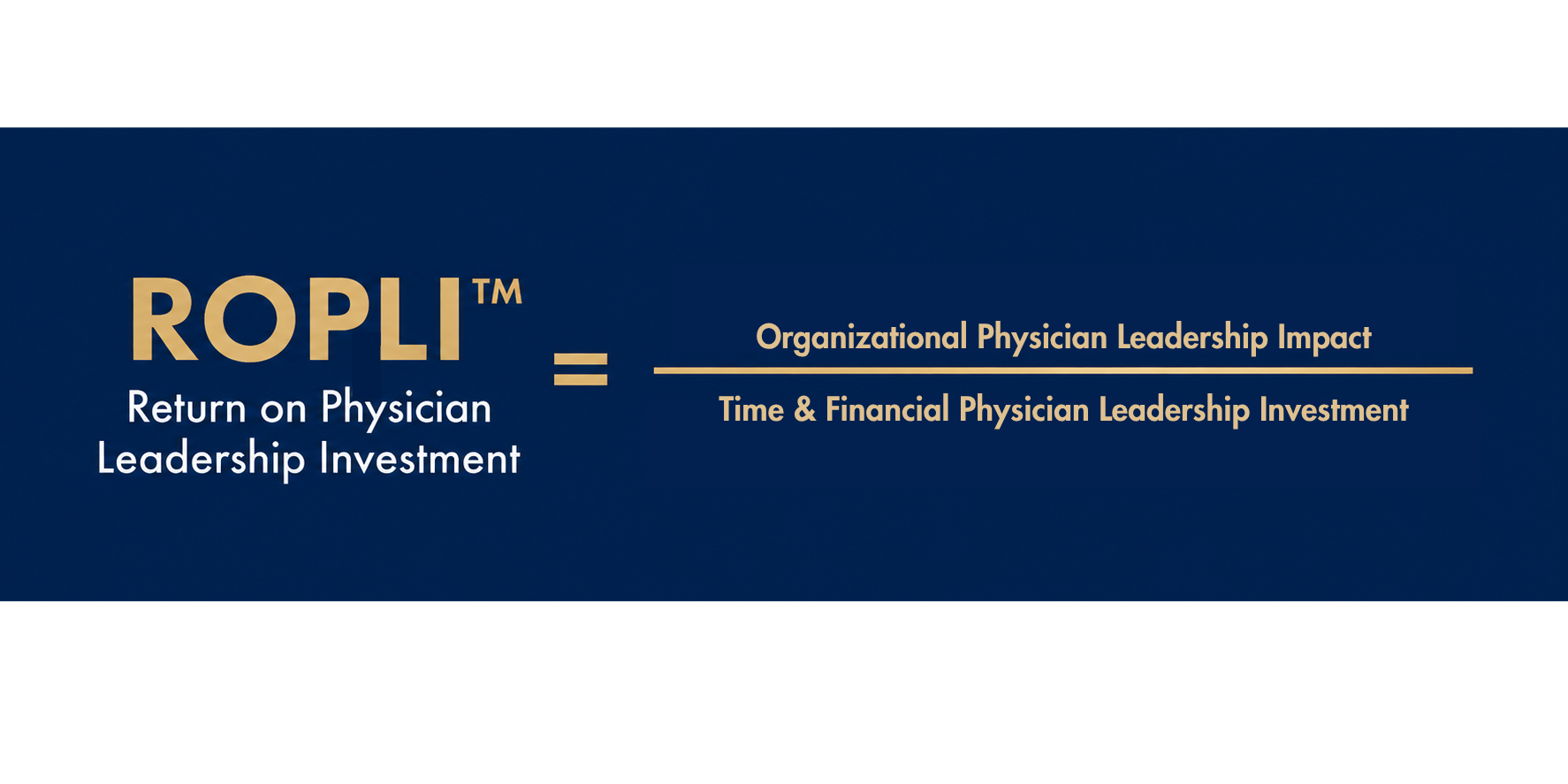
Like any ratio, ROPLI™ is optimized by increasing the numerator while decreasing the denominator. In other words, the goal is to maximize the organizational physician leadership impact relative to the time and financial investment required to achieve it.
Understanding the Denominator: Physician Leadership Investment
Let’s start with the denominator, the easiest to quantify financially speaking. It includes all the expenses associated with developing physician leaders. And it's not just the cost of bringing in generic leadership development speakers or sending physicians to conferences. It's also the opportunity cost of pulling them out of clinic or the operating room to participate in these experiences. Also, it’s the cost of their 0.2 Department Chair FTE when they could have been seeing patients or the stipend they are paid for doing this work.
These experiences have value. When I teach leadership, I often say that the best way to become a better leader is to actually lead. However, many traditional leadership development experiences aren't specifically targeted to the individual leader or the challenges they face. That limits their potential impact on the numerator and, ultimately, your ROPLI™.
Importantly, the denominator also includes the additional time healthcare administrators spend beyond their normal responsibilities coaching struggling physician leaders along and managing the consequences of ineffective physician leadership, including "cleaning up" after a poorly executed rollout of a physician-led initiative. That administrative time is expensive (you can calculate the hourly cost), even when it doesn't appear on a leadership development budget. (Physician friends, I know that stings, but it’s true, and it may not be your fault 🥺 .)
Physician Leadership Investment includes things such as:
Registration and travel fees if external conferences.
Contribution margin impact if removing physicians from patient care to attend.
Subscription costs for leadership modules on demand.
Coaching costs, internal or external.
Additional administrator time assisting struggling physician leaders.
The downstream costs of failed initiatives and organizational dysfunction when physician leaders cannot effectively engage their colleagues.
So, healthcare administrators, “you know” and can actually calculate much of the denominator. I knew that you know 😉.
Understanding the Numerator: What Does Effective Physician Leadership Look Like?
Now to the numerator. How do you know what your Total Organizational Physician Leadership Impact is? Again, “you know.” There isn't one universal formula for measuring it, but I know you recognize it when you see it. Think about three indicators: the strength of your internal physician leadership pipeline, the engagement of your medical staff, and the successful implementation and sustainability of physician-led clinical initiatives.
When Physician Leadership Impact Is High
Organizations with strong physician leadership impact often have a meaningful physician presence in the C-suite. Quality and safety outcomes may be better.
The Chief Medical Officer is respected by both administration and the medical staff. This individual can translate complex financial and clinical issues, effectively engage physicians, and successfully implement initiatives that improve organizational performance and patient care. This individual is well-trained in leadership and has refined their leadership skills through targeted development and coaching.
The Chief of Staff is highly effective in medical staff governance and works collaboratively with the CMO to support an effective medical staff and the delivery of high-quality patient care.
Department Chairs are engaged and eager to become better leaders. Some pursue advanced degrees or leadership coaching to strengthen their effectiveness and prepare themselves for future Chief of Staff and Chief Medical Officer opportunities. And each department chair, to the best of their ability, is identifying and developing a few department members for succession.
Importantly, physician leaders are developed from within rather than routinely recruited from outside the organization. The leadership pipeline is strong. Yes, “you know” when Total Organizational Physician Leadership Impact is high.
When Physician Leadership Impact Is Low
And also, “you know” when it is not. The opposite of the description above tends to be true. You tend to have to “hire in” physician leaders. You look at your leadership bench for Chief Medical Officer and Chief of Staff and shake your head. Department chairs are chosen on a rotating basis rather than demonstrated leadership ability. Initiatives that involve physicians, even if they are fully about patient outcomes, either fail or are partially implemented. Medical Staff meetings are poorly attended. There is no leadership pipeline.
It’s obvious; “you know” when Total Organizational Physician Leadership Impact is low.
ROPLI™ at the Initiative Level
ROPLI™ can also be calculated conceptually for an individual leadership development initiative.
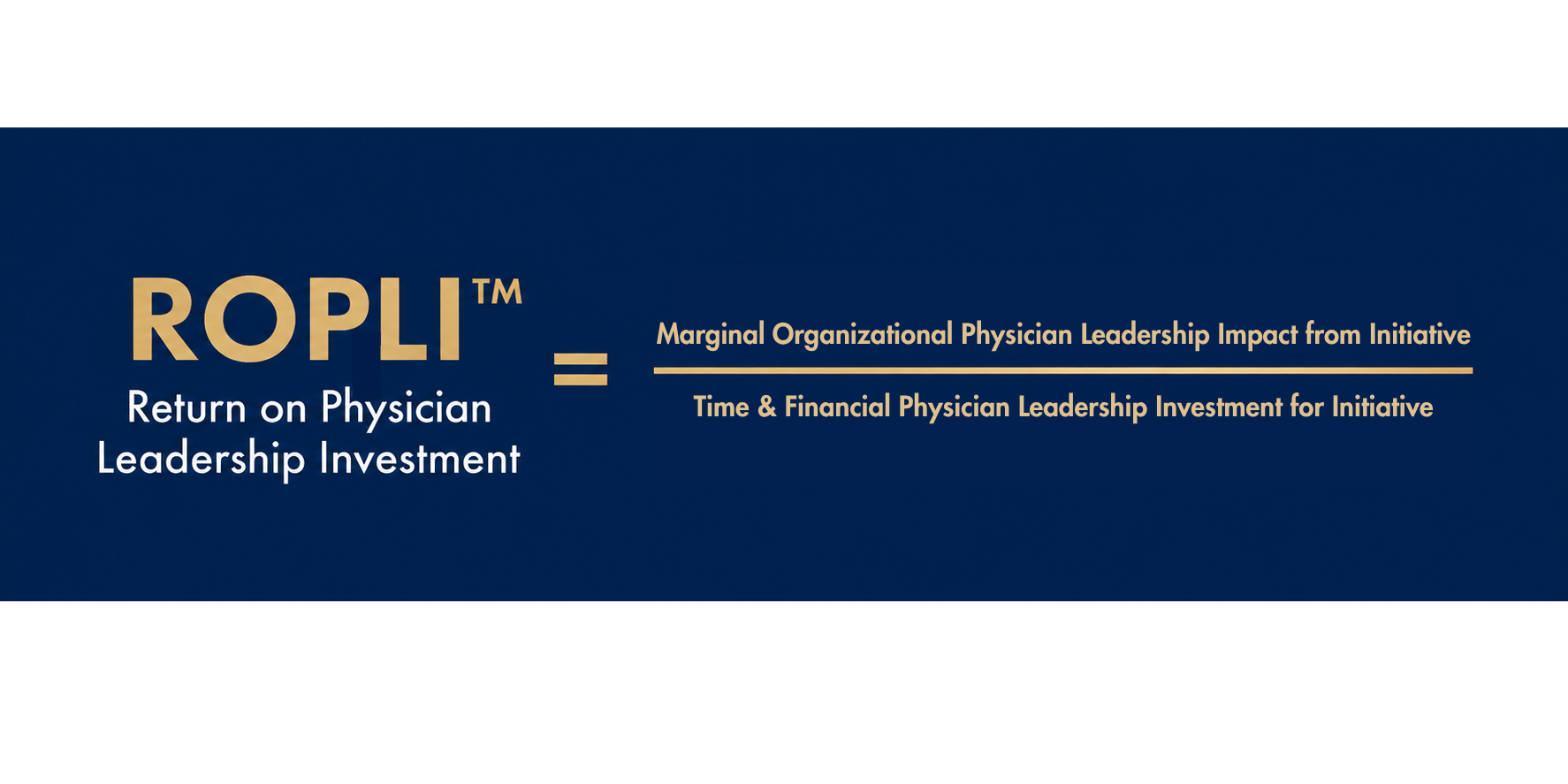
As an example, leadership conferences can be good investments. They expose physicians to new ideas, provide opportunities for networking, and allow them to learn from experienced leaders. I've attended conferences that have genuinely influenced my own leadership. However, exposure to leadership concepts, even excellent ones, doesn't necessarily translate into sustained behavioral change. That's where the approach to development matters.
Two Approaches to Physician Leadership Development
Let's compare two approaches to developing the same FIVE current and emerging physician leaders:
1️⃣ Sending them to a three-day leadership conference, requiring five days away from their clinical and organizational responsibilities, including travel.
2️⃣ Providing nine months of individualized, targeted, diagnostic-driven leadership development coaching.
The Denominator: Financial Investment 💰
1️⃣ Three-day Conference:
Conference Registration = $2,500
Flight = $400
Hotel (4 nights) = $1300
Meals = $500
Estimated Contribution Margin Loss, not including downstream revenue (Primary Care) = $500/day x 5 days
Estimated Contribution Margin Loss (Surgeon) = $5000 x 2 OR days + $500 x 3 clinic days
Assuming 2 Surgeons and 3 Primary Care physicians attend:
Conference Registrations = $12,500
Flights = $2000
Hotels = $6500
Meals = $2500
Estimated Primary Care Contribution Margin Loss (5 days) = $2500 x 3 docs = $7500
Estimated Surgeon Contribution Margin Loss (5 days) = $11,500 x 2 docs = $23,000
Total Cost for Conference = $54,000
2️⃣ Nine months of Coaching:
Nine months of assessment, coaching, and follow-up = $8500/doc.
No loss of clinical contribution margin, as coaching sessions can be scheduled outside patient care hours.
Physician time remains an investment, but clinical responsibilities are not displaced.
Total Cost for Coaching = $42,500
The Numerator: Leadership Impact 🚀
1️⃣ Three-day Conference:
A short-term motivational boost, with the risk of succumbing to the Ebbinghaus Forgetting Curve.
Exposure to valuable leadership concepts and interesting "nuggets," although much of the content may be general rather than contextually relevant.
Opportunities for external networking and understanding how other organizations approach leadership challenges.
Potential improvement in employee survey responses regarding opportunities for professional growth (“checking the box”).
The risk of returning to an unchanged organizational culture, where initial enthusiasm fades and new ideas struggle to gain traction.
2️⃣ Nine months of Coaching:
Individualized, diagnostic-driven assessment and targeted leadership development.
Identification of leadership blind spots and opportunities for growth.
Objective measurement of behavioral change through repeat administration of a validated assessment.
Sustained accountability through regular check-ins and progress toward specific micro-goals.
Application of leadership concepts to real-world challenges as they arise.
Development that extends beyond the individual physician to influence colleagues, teams, and the broader organization.
What Does the Comparison Tell Us?
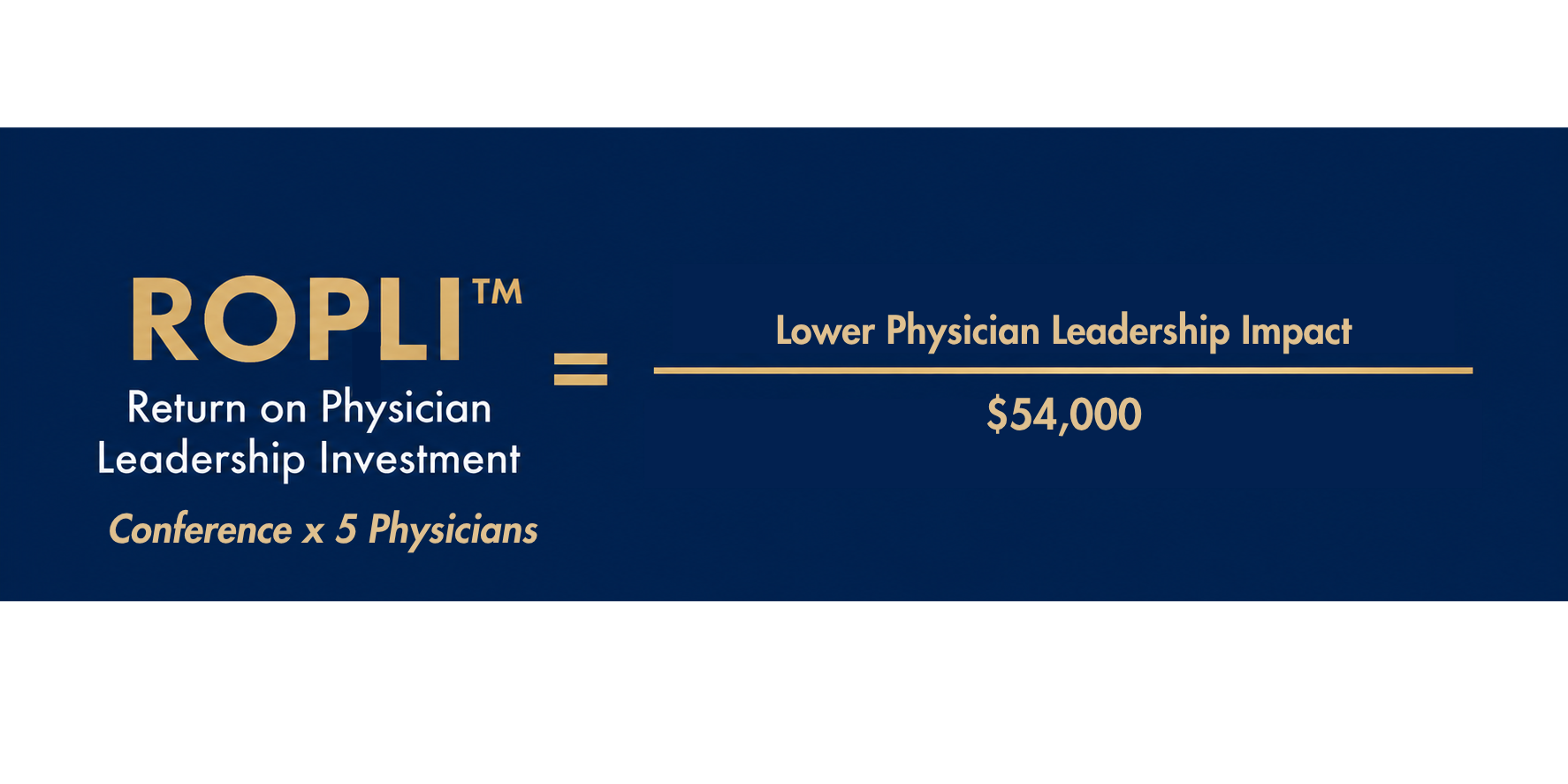
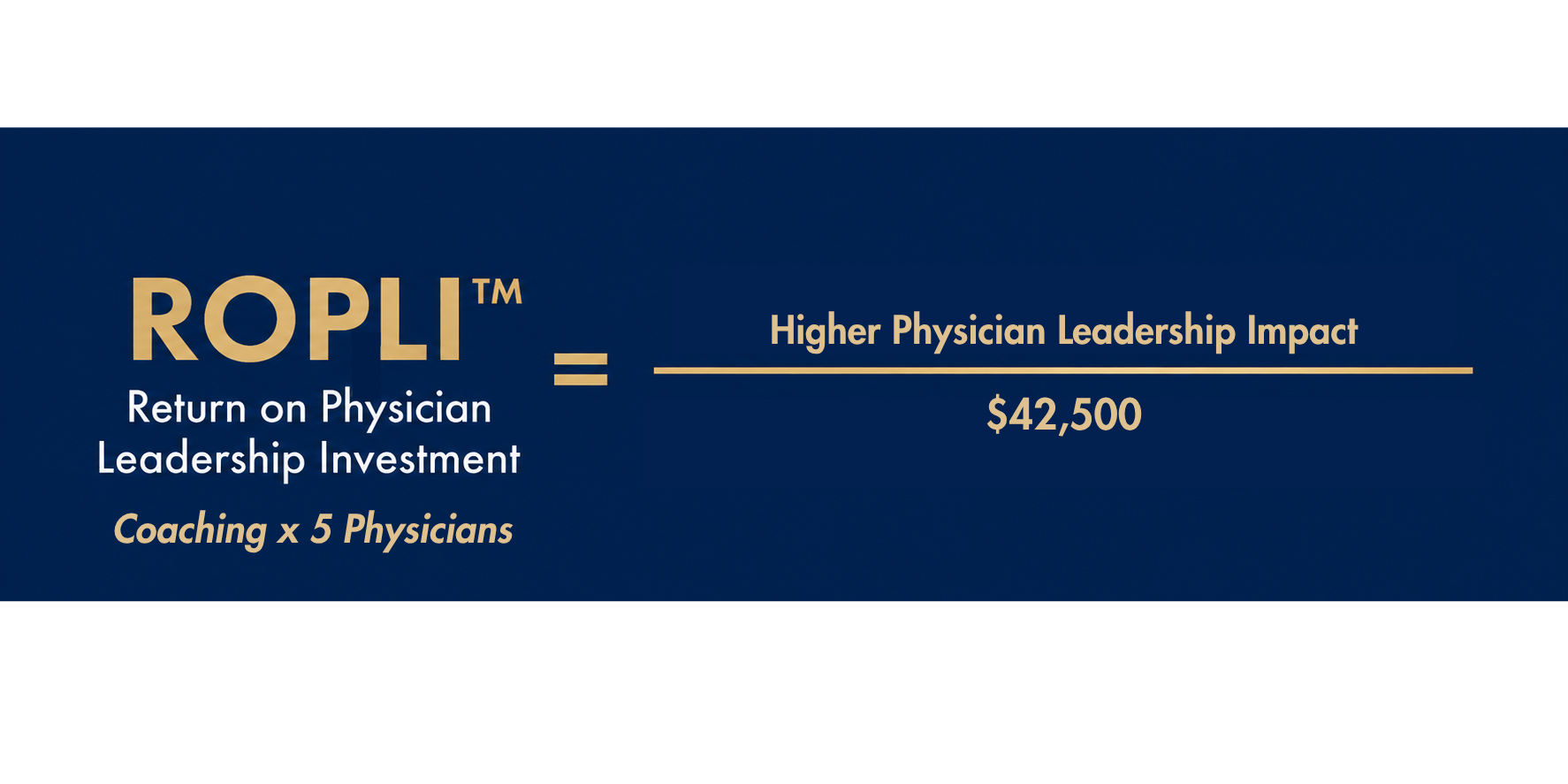
The coaching approach combines a lower financial investment with more individualized, measurable, and sustained physician leadership development, potentially producing greater organizational impact and, ultimately, a higher ROPLI™.
But ROPLI™ isn't just about comparing conferences with coaching.
💡 The same methodology can be applied to virtually any physician leadership development initiative, from leadership book discussion groups and workshops to formal leadership programs.
The question isn't simply how much an initiative costs. It's what the organization gets in return for that investment.
That's the value of knowing your ROPLI™.
My Challenge to Healthcare Executives
Calculate and carefully consider your ROPLI™, both at the organizational level over time and at the individual initiative level.
What is the fastest, most efficient, and most effective way to develop your physician leaders?
What are the long-term organizational consequences of underinvesting in physician leadership development?
Are you measuring what you spend on physician development—or what you actually get back?
Let’s talk about your organizational approach to ROPLI™.
Jon Zlabek (JZ), MD, MBA, FSVM, FACP, is a physician executive and physician leadership coach with more than 25 years of clinical experience and a diverse leadership background, including roles as Chief Medical Officer, Medical Vice President, Board of Trustees member, and Chief of Staff. Through JZ and Me Physician Development, I help physicians build confidence, strengthen connection, and become exceptional leaders through diagnostic-driven physician leadership coaching. Learn more about my approach to physician leadership coaching.
Footnote: Healthcare executives routinely track dozens of financial, operational, and quality metrics, including: ROI, Operating Margin, ROA, Days Cash on Hand, Days in A/R, Collections Ratio, DSCR, Debt-to-Capitalization, Average Age of Plant, ALOS, LOSI, Occupancy Rate, ED Boarding Hours, Payer Mix Ratio, CLABSI, CAUTI, C. diff, MRSA, CCR, Contractual Allowance %, CMI, HAC, 30-Day Readmission Rate, LWBS, FTE per AOB, and Premium Labor Ratio. Now we add ROPLI™.